Zero-shot detection with a canonical reference
Use this recipe to find read positions that deviate from the supplied canonical RNA model. It uses a fitted null predictor, whitening transform, scale model, and calibration. You do not need a control sample at inference time or modification-labelled training data for your sample.
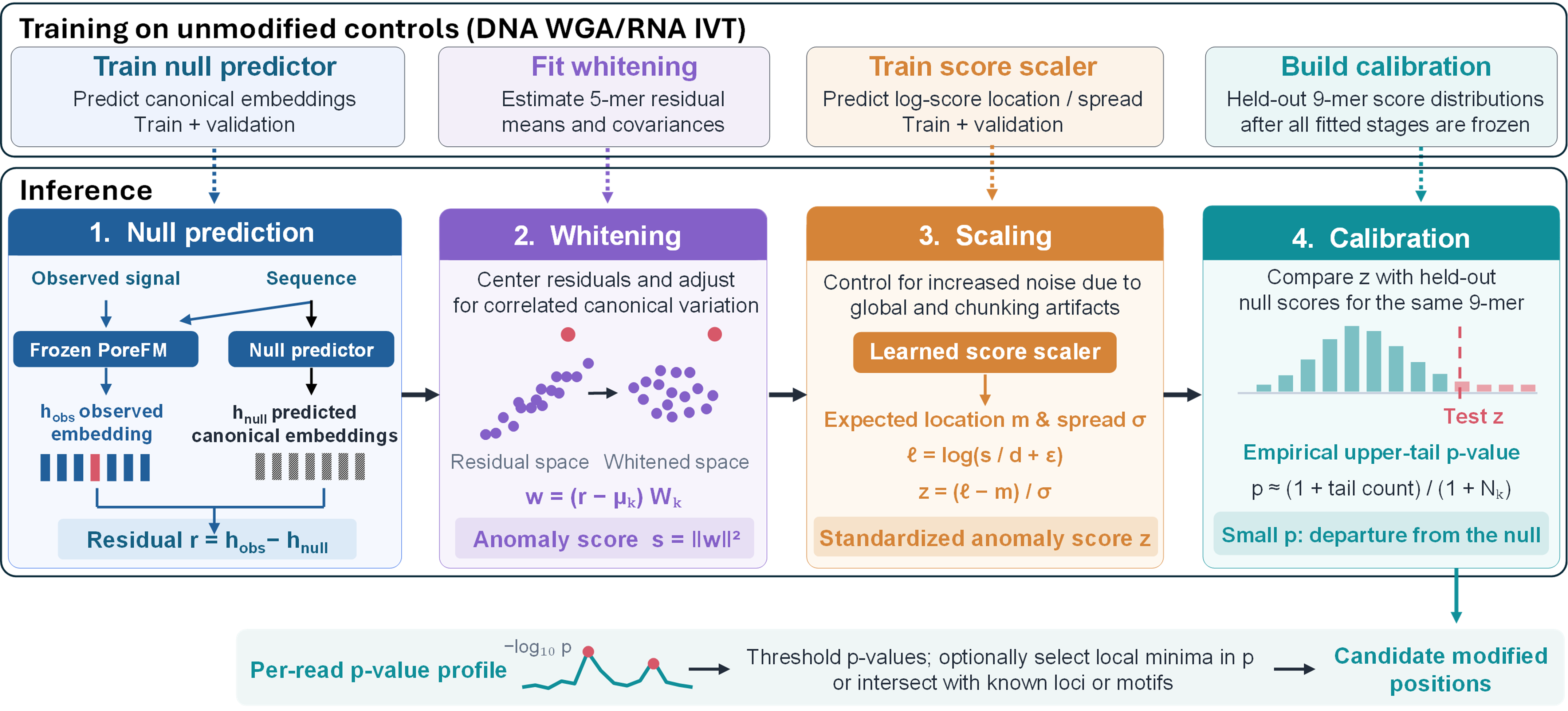
The training and fitting steps in the top row are already completed in the released bundle. You only need to run detection on your sample.
Follow input and model preparation. Supply basecalls.bam,
pod5/, and reference.fa with its .fai. The command downloads and caches
WGLab/PoreFM-RNA_zero-shot@v0.1.0, which contains all matching model components.
See Models to prefetch it for offline use.
basecalls.bam + POD5 --> backbone --> observed embedding
                                         |
sequence context --> null predictor --> expected canonical embedding
                                         |
                         observed minus expected
                                         |
                              whitening.pt
                                         |
                             residual distance
                                         |
                                scale model
                                         |
                            normalized anomaly score
                                         |
                               calibration.pt
                                         |
                              per-base p-value
                                         |
                         anomaly fraction at each site

The zero-shot bundle contains every model component shown above.
Whitening accounts for canonical residual variability. The scale model accounts for context-dependent score variation; calibration converts scores to tail p-values against the canonical reference. A small p-value indicates a deviation, not a named modification or the probability of modification.
Basic usage
porefm zero-shot detect \
  --bam_path basecalls.bam --pod5 pod5/ \
  --ref reference.fa --motif "N 0" \
  --model WGLab/PoreFM-RNA_zero-shot@v0.1.0 \
  --output_dir outputs/zero-shot
N 0 selects all eligible aligned bases across reference contigs. Calibration
metadata in the bundle selects the score type automatically. For a local
bundle, replace --model with --model-path models/RNA004_zero-shot.pt.
Summarize anomalies at reference sites
outputs/zero-shot/
|-- part_*_data.parquet       # Position, distance, score, p-value
|-- part_*_meta.parquet       # Read and alignment metadata
|-- run_manifest.json
`-- *.pfmi                   # Automatic BAM read-ID index, if needed
The basic command writes calls with raw distance greater than zero. To retain
a broad range of distances for site fractions, add --min_metric -1000 to the
detection command. Avoid restricting detection output to significant calls
or peaks: that removes calls needed for the denominator.
After detection finishes:
from pathlib import Path
from porefm.outputs import open_output

Path("summaries").mkdir(exist_ok=True)
calls = open_output("outputs/zero-shot")
calls.summarize_loci(
    modified_pvalue_cutoff=0.01,
    metric_columns=["distance"],
    metric_stats=["mean"],
    output_path="summaries/zero-shot.parquet",
    threads=4,
)
total_count counts retained valid p-values at a site. fraction_modified
is the output API's name for the fraction with p <= 0.01: interpret it as
an anomaly fraction, not modification stoichiometry. The summary also
includes mean distance and, by default, a Fisher combined p-value. Fisher
combination assumes independent observations; it does not identify the
chemical modification responsible for a signal change.
See processing outputs for common operations and zero-shot reference for specialized filtering.
Optional settings
Expanded command with window, filtering, and resource settings
Use this alternative for explicit signal windows, additional loader workers,
and broader read/call retention. --min_qscore 0 disables the default read
quality filter; --min_metric -1000 retains a broad range of raw distances.
These settings affect which calls enter downstream summaries.
Worker count and prefetch depth control input throughput. Checkpoint and log intervals control output writes and progress reporting.
porefm zero-shot detect \
  --bam_path basecalls.bam --pod5 pod5/ \
  --ref reference.fa --motif "N 0" \
  --model WGLab/PoreFM-RNA_zero-shot@v0.1.0 \
  --score_type auto \
  --size 4096 --step 3400 --num_trim 8 \
  --num_workers 4 --prefetch_factor 4 \
  --min_metric -1000 --min_qscore 0 \
  --checkpoint_batch_step 100 --log_every 100 \
  --output_dir outputs/zero-shot