Prototype-based joint footprinting
Call modifications using prototypes learned from small labelled datasets. The model uses footprinting to account for neighboring modification effects when assigning classes. The released prototype models support a broader set of modifications than the supervised classifiers, including types without a supervised model; see the model catalog.
This guide uses the released RNA model with the residual-effects scorer,
neighbor effects enabled, and a modification penalty of 50.
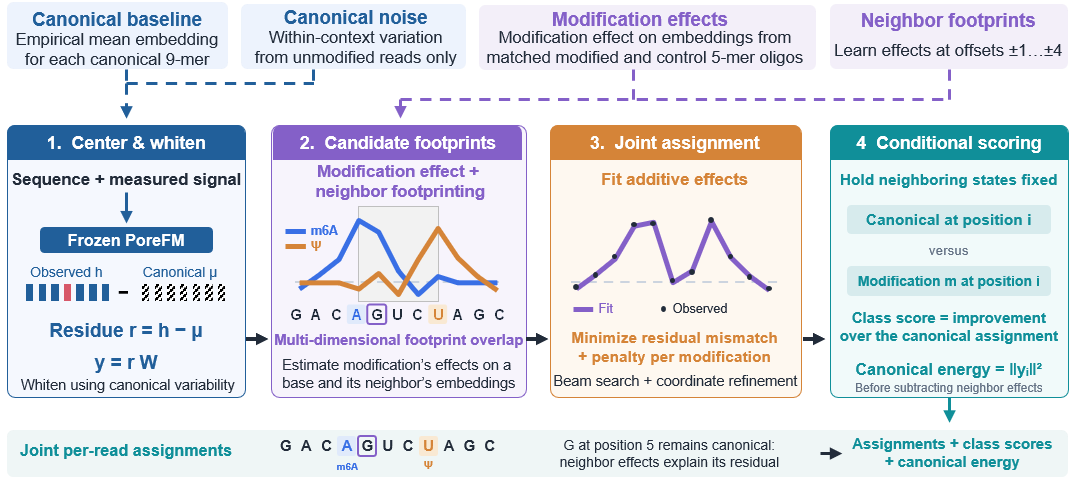
The canonical baseline, noise model, and modification effects shown at the top are already fitted in the released bundle. The command below performs scoring.
Follow input and model preparation. You need basecalls.bam,
pod5/, and reference.fa with its .fai. The command downloads and caches
WGLab/PoreFM-RNA_prototype@v0.1.0, which contains the backbone and matching
fitted effects. No prototype extraction or fitting is needed. See
Models to prefetch it for offline use.
basecalls.bam + POD5 --> backbone --> observed embeddings
                                            |
fitted effects --> expected canonical baseline + modification effects
                                            |
                        residuals measured using canonical noise
                                            |
                      jointly score center and neighboring states
                              (modification penalty = 50)
                                            |
                         per-base class calls + relative scores
                                            |
                          class frequencies at reference sites
The effect artifact supplies the canonical baseline, noise model, supported classes, and modification footprints. It must match the exact backbone used when it was fitted. Neighbor scoring helps explain a perturbation across several bases without treating every affected base as a separate event.
Basic usage
This example scores chr1. Replace it with the contig names in your BAM and
reference; --chrom accepts more than one name.
porefm prototype classify \
  --model WGLab/PoreFM-RNA_prototype@v0.1.0 \
  --effect_penalty 50 \
  --bam_path basecalls.bam --pod5 pod5/ --ref reference.fa \
  --chrom chr1 --motif 'N 0' \
  --output_dir outputs/residual
N 0 selects all eligible aligned bases. Neighbor effects and GPU scoring
are enabled by default. The penalty of 50 is part of this supplied RNA recipe;
it is not a p-value, an FDR threshold, or a universal setting for other models.
The bundle selects the residual-effects scorer. For a local bundle, replace
--model with --model-path models/RNA004_prototype.pt.
Summarize calls within each base family
outputs/residual/
|-- part_*_data.parquet       # Class calls and family-local scores
|-- part_*_meta.parquet       # Read and alignment metadata
|-- effect_parts.json        # Output parts, classes, completion state
|-- effect_run.json          # Effect model and scoring settings
|-- run_manifest.json
`-- *.pfmi                   # Automatic BAM read-ID index, if needed
After classification finishes:
from pathlib import Path
from porefm.outputs import open_output

Path("summaries").mkdir(exist_ok=True)
calls = open_output("outputs/residual")
calls.summarize_loci(
    relative_frequencies=True,
    include_class_counts=True,
    output_path="summaries/residual.parquet",
    threads=4,
)
count_LABEL counts hard class calls. freq_LABEL_rel divides a class count
by all called predictions in its canonical-plus-modified family: for example,
an A modification is divided by A and all modeled A modifications. The actual
labels and families come from the artifact. A family with no calls has a null
relative frequency. freq_LABEL instead divides by all called classes at
the site.
Keep canonical calls in these denominators. Unsupported contexts can produce
no-calls, so inspect called_count alongside total_count. Stored effect
scores compare classes given inferred neighbors; they are not calibrated
probabilities.
See processing outputs for common operations and the effect-model reference for scoring details.
Optional settings
Expanded command with window, filtering, and resource settings
This Bash example reads every reference contig from the FASTA index and sets signal windows, read filtering, and resource limits explicitly.
Batch size, workers, cache, block, and queue sizes control resource use.
The effect cache alone can use up to 4096 MiB here; reduce --effect_cache_mb
and --batch_size on smaller GPUs. Beam width and sweep count control the
approximate search for joint class assignments.
REF=reference.fa
mapfile -t CHROMS < <(cut -f1 "${REF}.fai")

porefm prototype classify \
  --model WGLab/PoreFM-RNA_prototype@v0.1.0 \
  --effect_neighbors on --effect_penalty 50 \
  --bam_path basecalls.bam --pod5 pod5/ --ref "$REF" \
  --chrom "${CHROMS[@]}" --motif 'N 0' \
  --size 4096 --step 3400 --num_trim 8 \
  --min_qscore 0 --min_read_length 100 \
  --batch_size 64 --reads_per_chunk 10 \
  --num_workers 4 --prefetch_factor 4 \
  --device cuda --effect_device cuda \
  --effect_cache_mb 4096 --effect_threads 4 \
  --effect_beam_width 32 --effect_max_sweeps 8 \
  --effect_block_size 4096 --effect_queue_size 8 --effect_queue_mb 512 \
  --seed 0 --log_every 100 \
  --output_dir outputs/residual