PoreFM
A foundation model for nanopore signal and sequence.
PoreFM uses raw electrical signal and nucleotide sequence to detect DNA and RNA modifications and compare samples.
Run the RNA example Install Models
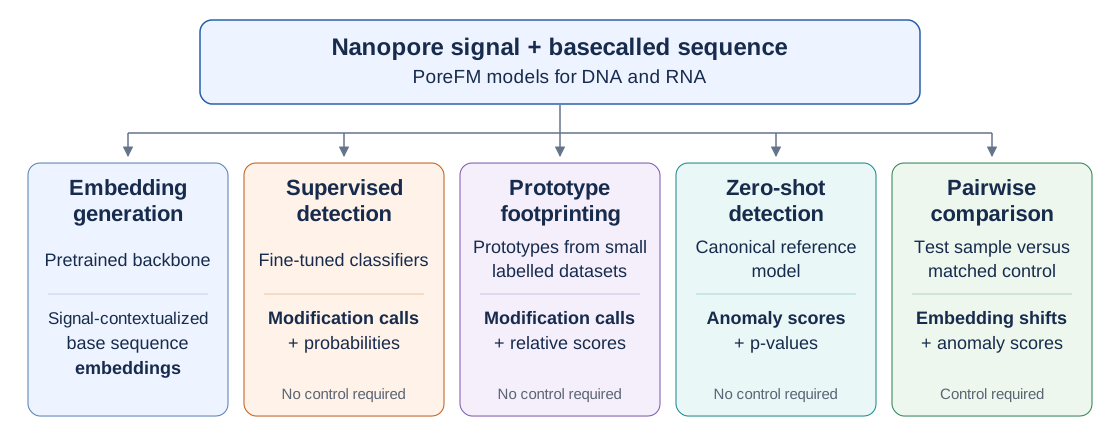
Choose an analysis
| Your goal | Method | Control sample at inference | Result |
|---|---|---|---|
| Call modifications with a fine-tuned classifier | Supervised detection | No | Trained class calls and probabilities |
| Call a broader set of modifications using learned prototypes | Prototype joint footprinting | No | Supported modification calls and relative scores |
| Find departures from canonical signal expectations | Zero-shot detection | No | Anomaly scores and p-values |
| Compare a sample with a matched control | Pairwise comparison | Yes | Embedding shifts and test-read anomaly scores |
Supervised models use a classifier trained on labelled data. Prototype models learn modification prototypes from small labelled datasets and use footprinting to account for neighboring effects. Both use contextual PoreFM representations. The released prototype models cover more modification types, including some without a supervised model; see the model catalog.
The released models include their trained components; no model training or prototype fitting is needed to follow these inference guides. Zero-shot detection is also called de novo detection: it flags departures from a canonical model without assigning a modification identity.
Choose a release matching your sequencing chemistry: RNA004 or DNA R10.4.1 (E8.2, 400 bps). The model catalog lists the modifications supported by each classifier and prototype model.
All four methods produce read-level results that can be summarized at reference sites. Anomaly fractions, class-call fractions, and mean probabilities measure different quantities; see output interpretation.
Getting started
- Install PoreFM.
- Run the HeLa RNA example for a first result and a comparison of all four methods.
- Prepare your own inputs and follow the relevant analysis guide.
- Summarize and explore your results without loading a model.
For custom analyses, export per-base embeddings. For questions, citations, and license information, see project information.